

Reviewed by
Adv. Deepak Sonu, Co-Partner, Vakil Labs
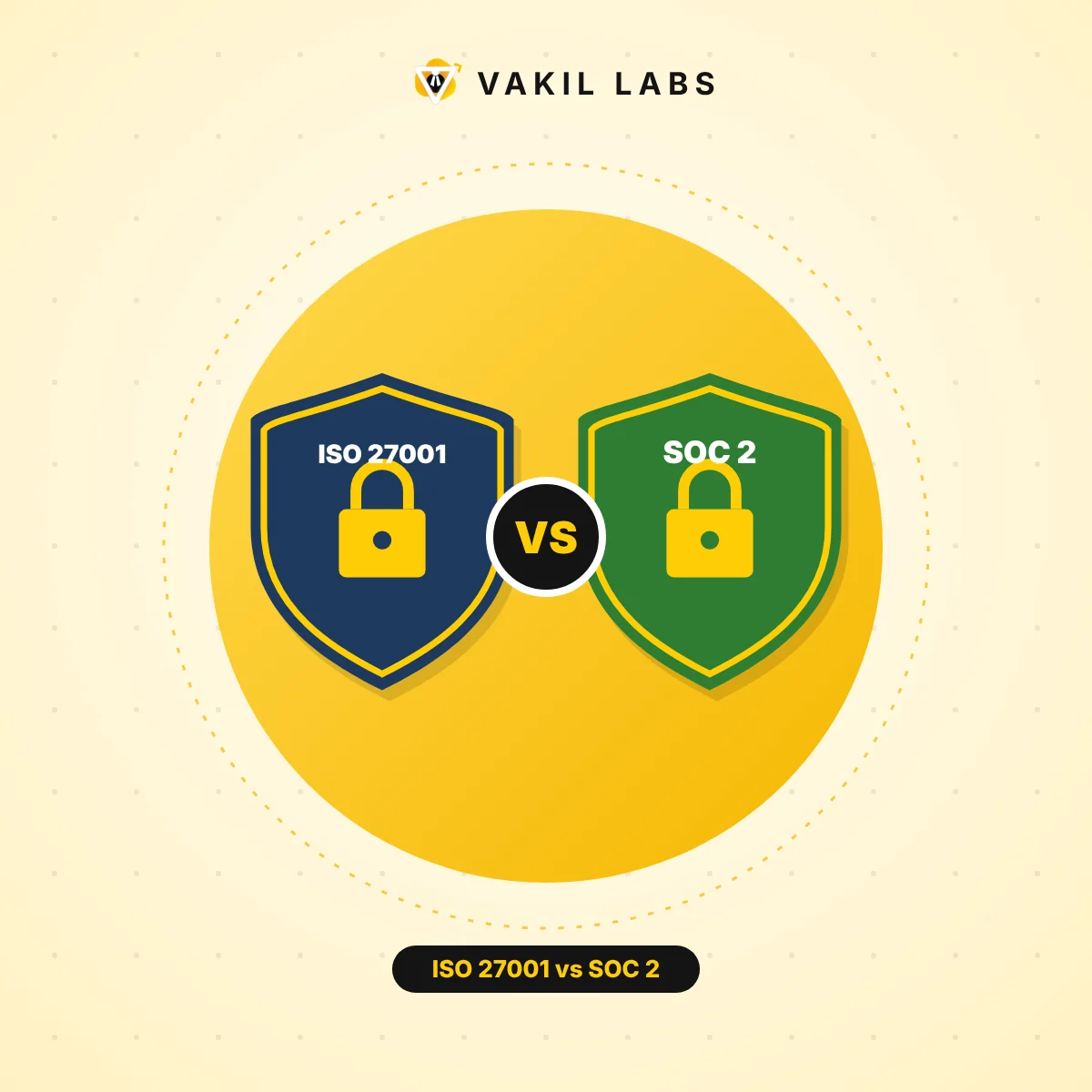
ISO 27001 is an international certification of your information security management system, issued by a certification body and valid for three years with yearly surveillance audits. SOC 2 is not a certificate at all: it is an attestation report on your controls, issued by an independent licensed CPA firm under AICPA standards, and it is mainly requested by customers in the United States. If most of your customers are in India, Europe or the Middle East, start with ISO 27001; if your pipeline is mostly US SaaS buyers, plan for SOC 2, and design one control set that can serve both.
This guide compares the two side by side, shows how Indian IT and SaaS companies usually sequence them, and lists the mistakes that waste months of effort.
ISO 27001 and SOC 2 at a glance
| Point | ISO/IEC 27001:2022 | SOC 2 |
|---|---|---|
| What it is | Certification against an international standard | Attestation report under AICPA’s Trust Services Criteria |
| Who issues it | A certification body after a Stage 1 and Stage 2 audit | An independent licensed CPA firm |
| What it covers | The whole ISMS: context, risk assessment, leadership, Statement of Applicability and 93 Annex A controls | Controls relevant to the criteria you choose: Security is always included; Availability, Processing Integrity, Confidentiality and Privacy are optional |
| Output | A certificate with a defined scope | A detailed report shared under NDA with customers |
| Validity | Three years, with surveillance audits in years two and three | Usually renewed every year; a Type II report covers a past period |
| Where it is asked for | India, Europe, Middle East, government and BFSI tenders | United States and US-headquartered customers |
The key difference: management system vs controls report
ISO 27001 asks, “Do you run a management system that identifies risks and keeps improving security?” The auditor checks your clauses 4 to 10 (context, leadership, planning, support, operation, performance evaluation and improvement) and samples the Annex A controls you declared applicable.
SOC 2 asks, “Were the controls you described designed properly, and did they operate effectively?” A Type I report tests the design of controls at a single point in time. A Type II report tests whether the controls operated over an observation period, typically three to twelve months. Most enterprise buyers want Type II.
Which one does your company need?
- Customers in India, the EU, the UK or the Gulf: ISO 27001 is the more recognised credential and is often written into tenders and vendor questionnaires.
- US enterprise customers: procurement teams usually ask for a SOC 2 Type II report and may not accept ISO 27001 in its place.
- Mixed customer base: build the ISMS once and map it to both. Many SOC 2 Security criteria overlap with ISO 27001 controls; the extra work is mainly evidence over the observation period and the system description.
- Handling personal data of Indian users: neither one is a substitute for the Digital Personal Data Protection Act, 2023. ISO 27701 or a separate DPDP programme covers notice, consent and rights.
Worked example
A 60-person SaaS company in Chennai sells HR software to Indian corporates and has just signed its first two US customers. One Indian bank customer requires ISO 27001 at renewal in nine months; the US customers ask for a SOC 2 report within a year.
A practical sequence: run a gap assessment, implement the ISMS and complete the ISO 27001 Stage 2 audit first. Start the SOC 2 Type II observation period as soon as the controls are live, so the same access reviews, change approvals, backups and incident logs become evidence for both. The company avoids running two separate projects and two sets of policies.
Step-by-step: getting ready for both
- Define scope: the product, cloud environment, offices and teams in scope. Keep it aligned for both frameworks.
- Gap assessment: compare current practice with ISO 27001 clauses, Annex A and the SOC 2 criteria you will include. This usually takes one to two weeks.
- Risk assessment and treatment: required by ISO 27001 and expected by SOC 2 auditors.
- Policies and controls: access control, onboarding and exit, change management, secure development, vendor management, logging, backup, incident response and business continuity.
- Evidence collection: tickets, approvals, review records and screenshots, kept month by month.
- Internal audit and management review: mandatory for ISO 27001 before certification.
- External audits: the ISO 27001 Stage 1 and Stage 2 audit by a certification body, and the SOC 2 examination by a CPA firm.
What to check in your customer contracts
Security frameworks and contracts meet in the master services agreement and the data processing agreement. Before you sign, read these clauses carefully:
- “Maintain ISO 27001 certification” or “provide an annual SOC 2 Type II report”: make sure the promised scope matches what your certificate or report actually covers, and that the dates line up with your audit cycle.
- Right to audit: offer your certificate or report first, with on-site audits limited in frequency, notice and cost.
- Breach notification timelines: a 24-hour or 48-hour customer notice must sit alongside your CERT-In and DPDP obligations, so your incident process has to meet the shortest deadline.
- Sub-processors: customers may require you to flow down security terms to your cloud and SaaS vendors, which means your own vendor contracts need matching clauses.
Getting these clauses right is often as important as the audit itself, because a missed contractual promise can become a breach claim even when your security is sound.
Common mistakes and red flags
- Buying a “SOC 2 certificate”: there is no such thing. Only a licensed CPA firm can issue a SOC 2 report.
- Using 2013-edition templates: ISO 27001:2013 certificates expired after 31 October 2025. Current work must follow the 2022 edition with its 93 controls.
- Paper policies with no evidence: a Type II auditor will sample records across the whole period; missing months are reported as exceptions.
- Scope that excludes the real product: a certificate covering only an office, not the production cloud, rarely satisfies customers.
- Ignoring Indian law: CERT-In’s direction to report specified cyber incidents within six hours and the DPDP Act apply regardless of which framework you choose.
Frequently asked questions
Is SOC 2 valid in India?
SOC 2 is a US attestation framework, but Indian companies serving US customers routinely obtain SOC 2 reports from CPA firms. It has no legal status under Indian law; it is a contractual and commercial requirement.
Which is faster, ISO 27001 or SOC 2?
ISO 27001 implementation typically takes eight to sixteen weeks before the certification audit. A SOC 2 Type I can follow soon after controls are in place, but a Type II needs an observation period, so the first Type II report usually takes longer.
Can one audit cover both?
No. They are separate engagements by different kinds of auditors, but one well-designed control set and one evidence trail can support both.
Does Vakil Labs issue ISO certificates?
No. Vakil Labs provides ISO consulting: gap assessment, implementation, internal audit and audit coordination. Certification audits are arranged through our tie-up with Veritas International, a JAS Global Certifications brand.
Related reading
For a full list of what an ISO 27001 auditor checks, see our ISO 27001:2022 checklist for IT and SaaS companies.
Talk to us
Vakil Labs helps IT and SaaS companies prepare for ISO 27001 certification and SOC 2 readiness, alongside DPDP Act and data privacy work. Companies that want security, privacy, contracts and labour compliance handled by one accountable team can use our Legal Retainer for Companies. Contact us or call +91 99416 26224. Book a call with an advocate
This article is for general information only and isn’t legal advice.