


Reviewed by
Adv. Deepak Sonu, Co-Partner, Vakil Labs
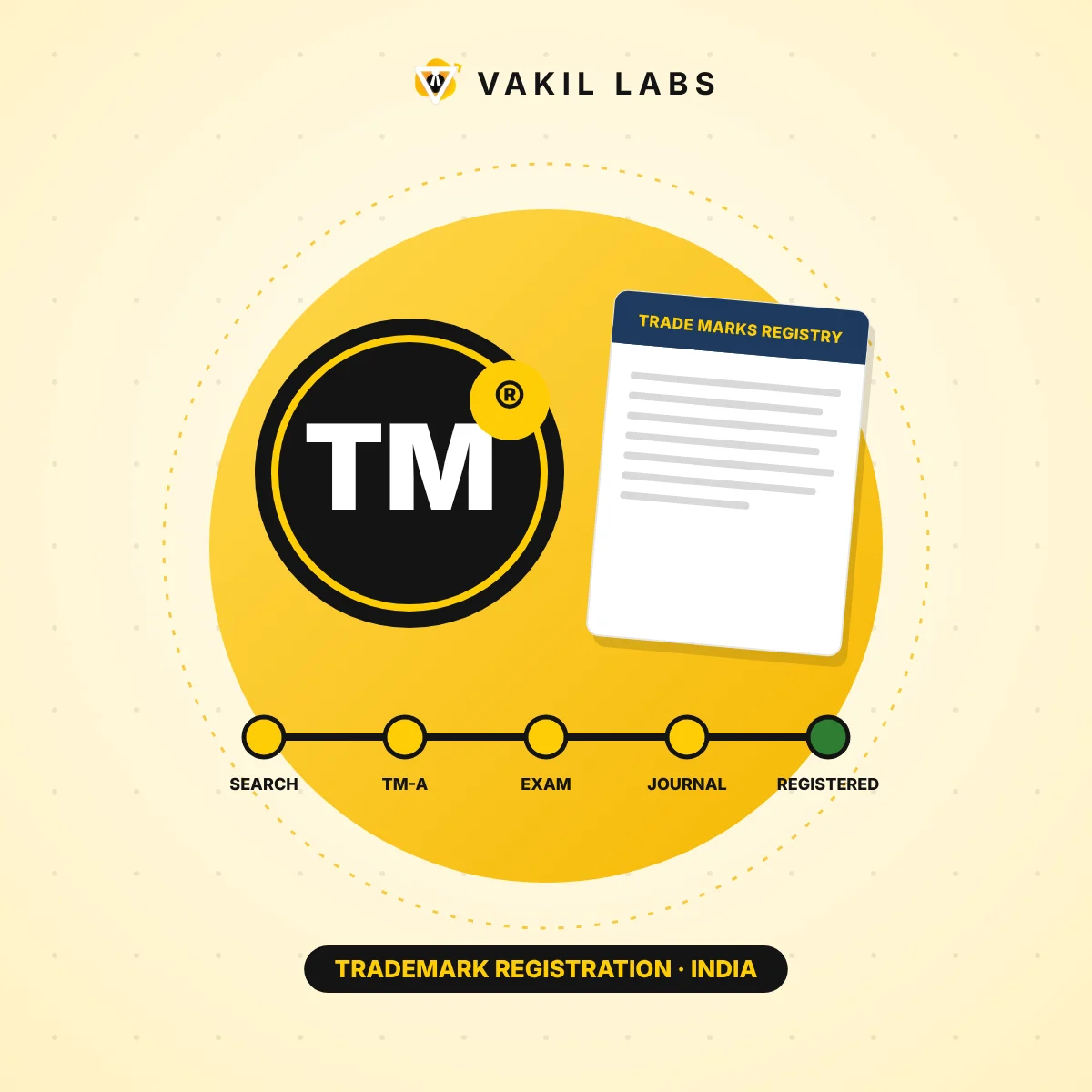
To register a trademark in India, you search for conflicting marks, file Form TM-A online with the Trade Marks Registry in the right class, answer any examination report within one month, and wait out the four-month opposition period after your mark is advertised in the Trade Marks Journal. If nobody opposes, the mark is registered and is valid for 10 years from the filing date, renewable every 10 years. An unopposed application commonly takes around a year or more end to end; an opposed one can take much longer.
This guide covers what can be registered, the step-by-step process, official fees, realistic timelines, and the mistakes that most often delay businesses.
What can be registered as a trademark?
A trademark is any mark that can be represented graphically and can distinguish your goods or services from those of others (Section 2(1)(zb), Trade Marks Act, 1999). It can be a word, logo, slogan, label, shape of goods, packaging or a combination of colours.
The Registry will refuse marks on absolute grounds (Section 9): marks that lack distinctiveness, simply describe the product (“Fresh Idli Batter”), are customary in the trade, are deceptive, or are prohibited by law. It will also refuse marks on relative grounds (Section 11): marks identical or similar to an earlier mark for similar goods or services, where the public is likely to be confused.
Invented or arbitrary words (like a coined brand name) are the easiest to register and protect. Descriptive names are the hardest.
Step-by-step process
Step 1: Search before you file
Run a public search on the IP India portal for identical and similar marks in your class, including phonetic variations and logo (Vienna code) searches. A clash found now costs nothing; a clash found after launch can mean rebranding.
Step 2: Choose the class and description
Goods and services are classified under the Nice Classification (Rule 20, Trade Marks Rules, 2017): 45 classes, 34 for goods and 11 for services. A software company may need Class 9 (software) and Class 42 (SaaS and IT services); a restaurant needs Class 43. Describe your goods and services precisely, because the registration only protects what you list.
Step 3: File Form TM-A
Applications are filed with the Registry office that covers your principal place of business (Section 18). Businesses based in Tamil Nadu file with the Chennai office, which also covers Kerala, Karnataka, Andhra Pradesh, Telangana, Puducherry and Lakshadweep. You can file on a “proposed to be used” basis, or claim earlier use with a user affidavit and supporting evidence such as invoices (Rule 25(2)). Once filed, you can use the ™ symbol.
Step 4: Examination report
An examiner checks the application against Sections 9 and 11 and issues an examination report. If objections are raised, you must reply within one month of receiving the report (Rule 33), or the application may be treated as abandoned. If the reply does not satisfy the examiner, a hearing is fixed.
Step 5: Advertisement in the Trade Marks Journal
Once accepted, the mark is advertised in the Trade Marks Journal (Section 20). Some marks are advertised before acceptance.
Step 6: Opposition window
Anyone can oppose within four months from the date of advertisement (Section 21; Rule 42). If an opposition is filed, you must file a counter-statement within two months, or the application is deemed abandoned. The parties then file evidence on strict timelines (Rules 45 to 47) before a hearing.
Step 7: Registration and certificate
If there is no opposition, or it is decided in your favour, the mark is registered and a certificate is issued (Section 23). Registration is treated as effective from the application date. Only now may you use the ® symbol. Falsely representing a mark as registered attracts a penalty under Section 107.
Official fees (e-filing)
| Form | Purpose | Individual / startup / small enterprise | Others |
|---|---|---|---|
| TM-A | New application, per class | ₹4,500 | ₹9,000 |
| TM-A (expedited) | Expedited examination, per class | ₹20,000 | ₹40,000 |
| TM-O | Opposition or counter-statement, per class | ₹2,700 | ₹2,700 |
| TM-R | Renewal, per class | ₹9,000 | ₹9,000 |
| TM-M | Extension of time and similar requests | ₹900 | ₹900 |
Source: IP India fee schedule. Physical filing costs more. Check the current schedule on ipindia.gov.in before paying, and keep your startup (DPIIT) or Udyam certificate ready if you claim the lower fee.
How long does it take?
| Stage | Typical time |
|---|---|
| Search and filing | A few days |
| Examination report | Varies with Registry workload; expedited examination is ordinarily within about 3 months of the request (Rule 34) |
| Reply to objection | Within 1 month of receiving the report |
| Opposition period after advertisement | 4 months (cannot be extended) |
| Registration if unopposed | Commonly around a year or more from filing; the Act aims at registration within 18 months (Section 23) |
| Opposed application | Often 1.5 to 2.5 years or more |
These are typical ranges, not guarantees. The Registry’s backlog changes; for example, it ran a special drive in early 2026 to clear pending examinations.
Worked example
A Chennai SaaS startup, registered as a Private Limited company with Udyam registration, wants to protect its product name and logo. A search shows a similar word mark in Class 35 but nothing in Classes 9 and 42. It files one TM-A covering Classes 9 and 42 for the word mark (2 × ₹4,500) and a separate application for the logo. The examiner raises a Section 11 objection citing a similar Class 42 mark; the company replies within the month, showing the marks differ in sound and meaning and the cited mark covers unrelated services. The objection is waived, the mark is advertised, the four months pass without opposition, and the certificate issues. Meanwhile, the company has used ™ from the filing date.
Documents usually needed
- Applicant’s name, address and nationality; for a company or LLP, the certificate of incorporation
- The mark: the word in plain text and/or a clear logo image
- Class and description of goods or services
- Date of first use, with a user affidavit and evidence such as invoices or ads (if claiming prior use)
- DPIIT startup recognition or Udyam/MSME certificate (for the lower fee)
- A signed authorisation (power of attorney) if an advocate or trade mark agent files for you
Common mistakes and red flags
- Filing a descriptive name and then fighting a Section 9 objection for months.
- Skipping the search and spending on a brand that clashes with an existing mark.
- Filing in the wrong class or with a narrow description that does not cover what you actually sell.
- Filing in a founder’s personal name and later having to assign it to the company.
- Missing the one-month reply or two-month counter-statement deadline, which can end the application.
- Using ® before registration.
- Forgetting renewal: renew within the 10-year term; a late renewal within 6 months costs a surcharge, and restoration after removal is possible only for a limited period.
FAQ
Can I start using my brand before registration?
Yes, and you can use ™ from filing. Unregistered marks are also protected through a passing-off action, but registration makes enforcement much easier.
Does a company name registration protect my brand?
No. MCA name approval and trademark registration are separate. If you are incorporating, read our guide to registering a Private Limited company in Chennai and file the trademark at the same time.
Where do trademark appeals go now?
After the Intellectual Property Appellate Board was abolished in 2021, appeals from Registry orders go to the High Courts. The Madras High Court has an Intellectual Property Division for such matters.
Is one application enough for word and logo?
They are usually filed as separate marks. The word mark protects the name in any style; the logo mark protects the design.
How Vakil Labs can help
Our trademark and copyright registration team runs the search, picks the classes, files TM-A, replies to examination reports and handles oppositions and renewals. If you are just starting up, our business and company registration service can incorporate the company and file the trademark together. Growing companies can keep IP protection, contracts, employment, POSH and compliance with one accountable team under our Legal Retainer for Companies.
Contact us or call +91 99416 26224. Book a call with an advocate
This article is for general information only and isn’t legal advice.